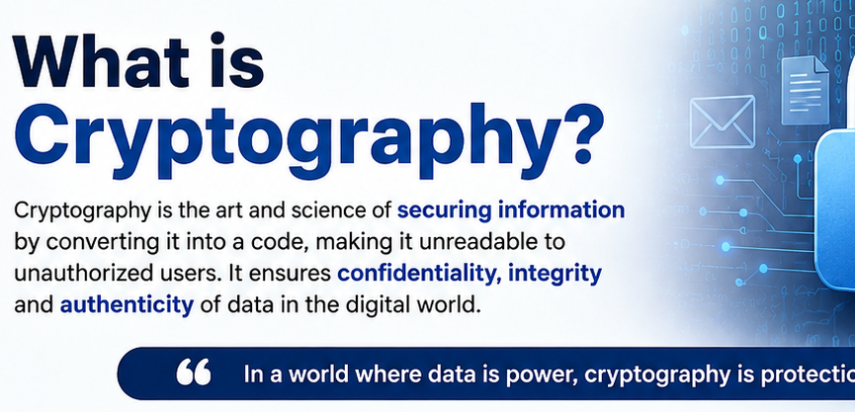
In today’s digital world, data is power—and cryptography is protection.
Cryptography is the science of securing information by transforming it into a form that unauthorized users cannot understand. It helps protect confidentiality, integrity, authenticity, and privacy.
🔑 3 Major Types of Cryptography
1️⃣ Symmetric Key Cryptography
It uses a single shared secret key for both encryption and decryption. It is fast and efficient, making it ideal for bulk data encryption, but requires secure key exchange.
👉 Example: Common algorithms include AES (Advanced Encryption Standard), DES (deprecated), and 3DES.
📌 Used for encrypting files, databases and large volumes of data.
2️⃣ Asymmetric Key Cryptography
It uses a pair of keys: a public key for encryption and a private key for decryption. This method solves the key distribution problem and is essential for secure key exchange and digital signatures.
👉 Example: Standard algorithms include RSA (Rivest-Shamir-Adleman), ECC (Elliptic Curve Cryptography), and Diffie-Hellman.
📌 The public key can encrypt data, while the corresponding private key is used to decrypt it.
3️⃣ Hash Functions
Converts data into a fixed-length digital fingerprint. It performs a one-way, irreversible transformation of data into a fixed-size string (digest). They are used to ensure data integrity and securely store passwords.
👉 Example: Prominent algorithms include SHA-2 (e.g., SHA-256), SHA-3, and the deprecated MD5 and SHA-1.
📌 Widely used for data integrity, passwords, digital signatures and blockchain.
🌐 Where do we use Cryptography?
🔒 Secure messaging 🌍 HTTPS & secure websites
₿ Cryptocurrencies & blockchain 🏦 Online banking & payments
☁️ Cloud data protection
In simple words: Cryptography is one of the fundamental technologies that enables us to communicate, transact and store information securely in the digital age. These types are often combined in hybrid systems (like TLS/SSL) to leverage the speed of symmetric encryption for data and the security of asymmetric encryption for key exchange. Additionally, Post-Quantum Cryptography is emerging to protect against future quantum computing threats, with NIST standardizing algorithms like ML-KEM and ML-DSA in 2024.
#Cryptography #CyberSecurity #Blockchain #Cryptocurrency #DataSecurity #DigitalSecurity #Encryption #SHA256 #AES #RSA #KnowCrypto #SWIFT, #BlockchainFinance, #HyperledgerBesu, #CrossBorderPayments, #DigitalBanking, #FinTechNews, #Tokenization, #JPMorgan, #HSBC, #FutureOfFinance, #BankingInnovation, #RealTimeSettlement, #EnterpriseBlockchain, #GlobalLiquidity
✍️ Written by: Amitabhh A. K. Bhatnagar
✍️ Note: If you are looking for any guidance on crypto investment, feel free to connect with me on WhatsApp only.
⚠️ Disclaimer: This post is for informational and educational purposes only. It does not constitute financial or legal advice. Please consult a certified professional before making investment or regulatory decisions.